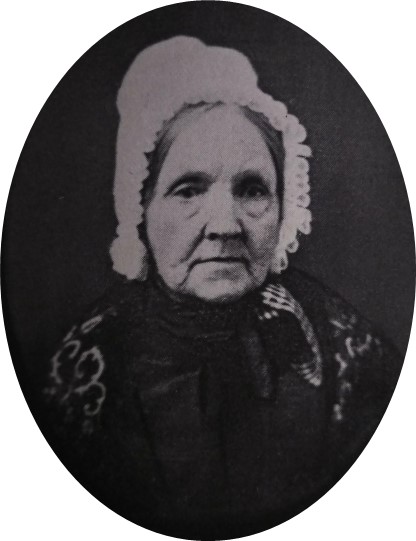
Most of what can be said about the life of Anna Marsh Power (1773-1858) revolves around her daughter’s relationship with Edgar Allan Poe, in which she played a significant role.
Anna was born on May 10, 1773 to Daniel and Susanna Wilkinson Marsh, both of whom were native Rhode Islanders. Her ancestors included a few noteworthy, albeit bizarre people, including America’s famous traitor, Benedict Arnold and the first American-born, woman-founder of a religious movement (turned cult-leader), Jemima Wilkinson. Mental illness was also quite prevalent in Anna’s bloodline.
Anna Marsh married Nicholas Power in Newport, Rhode Island in 1798. Their first child, Rebecca, was born two years later in 1800. Sarah Helen followed shortly after in 1803. Following Sarah was a baby girl, Susan, and a baby boy to take on the Nicholas name, Nicholas VII. However, both children died in infancy. Their third and final child, Susan Anna (named after her late sister) was born in 1813, shortly after Nicholas Power set out to sea, not to return for nineteen years.
What happened over the course of those nineteen years changed everything for Anna and her children. Nicholas Power’s vessel was caught by a British fleet shortly after his departure and he was held a prisoner of war for two years. Upon his release in 1815, he decided to continue his life at sea without ever notifying his family of his survival. He was presumed dead and Anna began the stages of mourning, donning a widow’s bonnet and listing herself in the Providence directories as “widow.” Alone and raising three young girls, Anna protect her daughters at all costs.
Anna had relatives in the Carolina’s that had left her large sums of money from their estate, however, she needed either her husband or her husband’s death certificate to claim the money. His conduct made it extremely difficult for Anna to collect the money she so desperately needed to support her family.
The Power girls moved into the red house we know today on Benefit Street in 1824. The oldest daughter, Rebecca, had married in 1821 and moved into a house just a few doors down with her husband. Sadly, she died shortly after that in 1825. Sarah Helen married and moved to Boston in 1828, and the youngest daughter, Susan, remained under the care of her mother due to her mental illness.
In 1832, Nicholas Power returned to his wife in a strange attempt to resume his family life. Naturally, Anna did not receive him well, removing her widow’s bonnet and promptly beating him with it until he was forced out of the front door. Anna had nothing to do with her husband after this and began a fervent distrust of men all together. Anna dealt with her husband one final time when his body lied in state during his wake at her home on Benefit Street in 1844.
Sarah Helen Whitman had returned home in 1833 after the death of her husband. Anna kept Sarah Helen and Susan tightly under her wing for the rest of her life. They all lived comfortably off of the money Anna was finally able to collect from her relatives, and it was for this reason that when Poe came along in 1848 to scoop Whitman off of her feet and take her away as his bride, Anna became very controlling of the situation.
Poe’s reputation negatively preceded him at this point in his life. Anna was not the only one among Whitman’s circle that strongly disapproved of the relationship between her and Poe. When the marriage seemed inevitable, Anna forced Whitman to sign over her inheritance so that Poe could not get his hands on it after the wedding. When this failed to corrupt the engagement, an anonymous note was passed to Whitman at the Athenaeum just days before the wedding was to take place. The note claimed that Poe had broken his vow of sobriety, which was one of the conditions Whitman set for the engagement. One can only wonder if Anna had anything to do with this note. Poe made his final plea to Whitman at her home. The confrontation was so distressing that Whitman had to inhale her ether-soaked handkerchief to remedy her heart condition. She passed out on the sofa, and that is when Anna had enough. She boldly stood over her daughter, and for the second time in her life she kicked a groveling man out of her house. Anna reminded Poe that the next train home leaves soon, and that he better not miss it. When the relationship was over, Poe blamed Anna Power for everything that went wrong. He even went so far as to call her “the devil.”
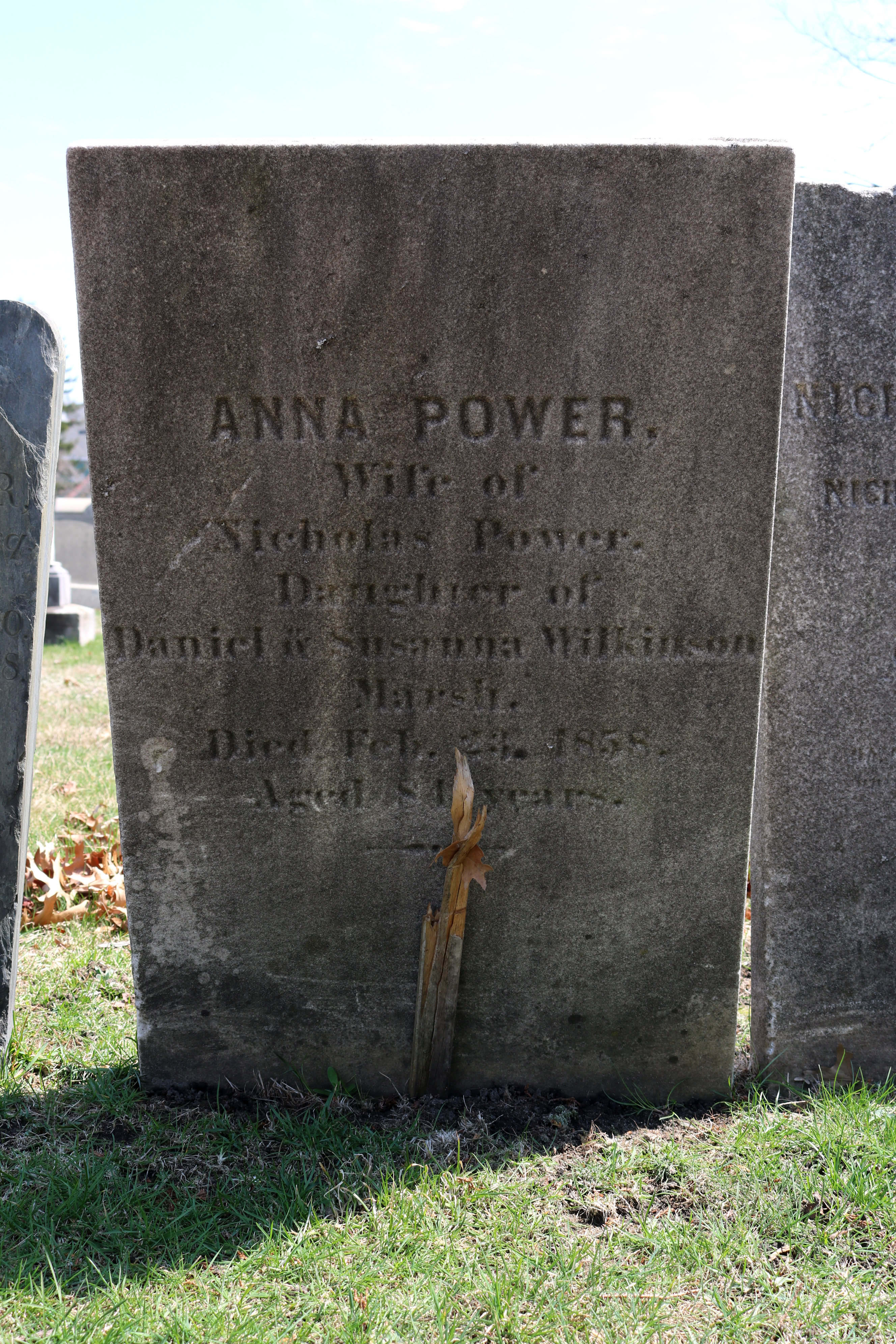
In her final years, Anna was bedridden. Whitman, now caring for both her mother and sister, would sit at her mother’s bedside and often read to her. Anna Power died on February 23, 1858, presumably of natural causes. She was 84 years old. She was interred next to her husband, Nicholas Power, at the North Burial Ground, and it is probably safe to say that she rolled over in her grave just as soon as she was put in it.
 Edgar Allan Poe: Rhode Island