In 1869, Sarah Helen Whitman commissioned her last known likeness in oil, completed by the Providence artist, John Nelson Arnold. This painting was not rendered from life, but by the use of Cephas Giovanni Thompson’s portrait as a reference. Whitman brought Thompson’s painting to Arnold, wishing to be rendered at that age in a new painting.
Arnold recalled that Whitman was present from the preliminary sketch of charcoal to the final stroke of paint on the canvas, advising him during the whole process. When it was finished, Whitman paid Arnold for his work and told him that this portrait was the one that she wished to go down to posterity.
Whitman had Arnold keep the finished painting in his studio, with the intention of it going to either The Providence Athenaeum or the Rhode Island Historical Society. When Whitman passed away in 1878, her executors mistakenly gave Arnold’s portrait to Brown University, the institution that Whitman intended Thompson’s portrait to go. The Providence Athenaeum, of course, was given Thompson’s portrait.
Although the paintings were mistakenly swapped between the institutions that Whitman intended for them to go, they have both had very good homes where they are. Each painting can be viewed by visiting the libraries. Much like Thompson’s portrait at The Providence Athenaeum, Arnold’s portrait is in a locked room on the second floor of the John Hay library called the Hermann Friedrich Bruhn room. Ask a staff member if they can let you into the room to see the painting.
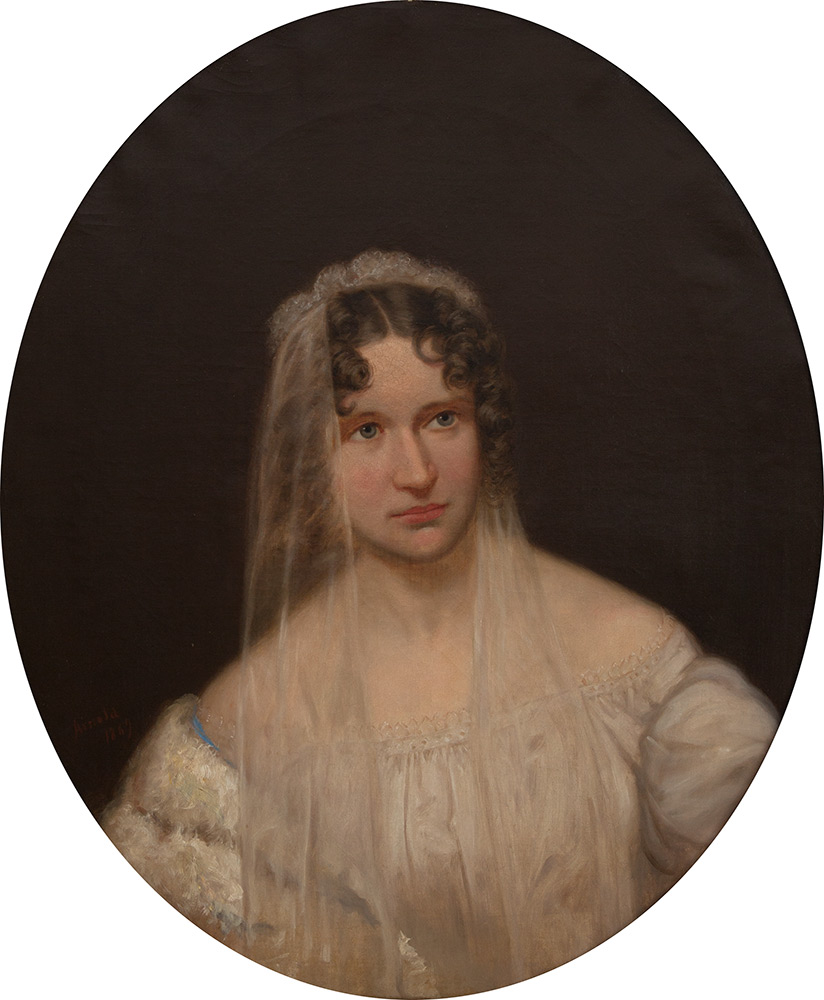
Scanned image of the Arnold’s portrait, courtesy of Brown University
Perhaps the greatest tribute (and possibly the only tribute) to this work of art was a poem written by the Scottish poet, Thomas C. Latto. Latto was a friend and admirer of Whitman who sent her this poem titled “Your Portrait” in a letter shortly before he published it in the Providence Journal on June 12, 1874:
“So fern, und doch so nah.”
Lady, when on my sight that sweet face beamed
Through the white veil, methought some vanish’d ray,
Some vision of a long-departed day,
Shone through its tranquil loveliness. It seemed
The face on which, in youth, I mused and dreamed,—
The face of one who never, never came.
How many hopes of mine since then have waned,
Till but the ling’ring glamour that remained
Sheds watery halos round life’s flickering flame.
For thee I pray that never could may lower,
Nor anguish touch the smile those features wear:
Though slight the boon, believe that, in this hour,
A heart-felt blessing greets thee, lady rare,
O wise as good, and good as thou art fair.
 Edgar Allan Poe: Rhode Island