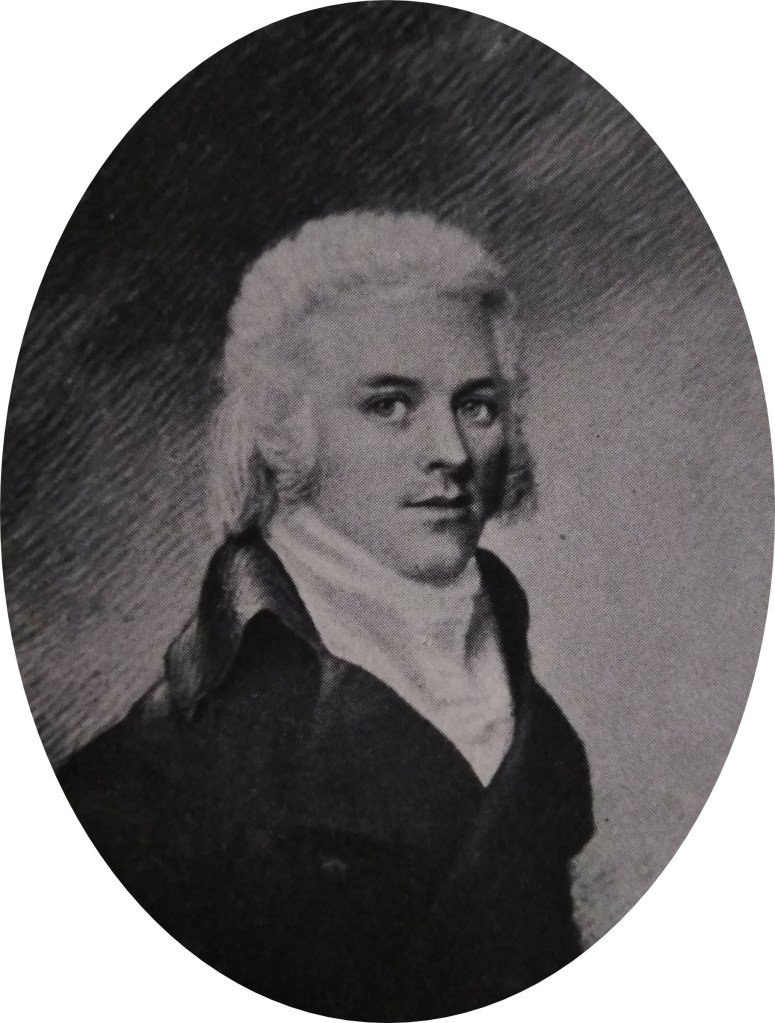
Sarah Helen Whitman’s father, Nicholas Power VI (1771-1844), led both an interesting and controversial life. He was born to Captain Nicholas V and Rebecca Cory Power on September 15. He married Anna Marsh in 1798, much to the dismay of his family. The Power name was rooted in Providence since the founding of the colony in 1636. The family name came with status and respect, while Anna Marsh’s name did not. Anna was descended from America’s famous traitor during the Revolution, Benedict Arnold. It is also evident that mental illness ran in her family.
Nicholas Power made his living as a merchant in Providence until the War of 1812 put him out of business. In 1813, he departed Rhode Island for North Carolina and began a seafaring life in an attempt to make some income. He ventured as far as the West Indies before his vessel was caught by a British fleet and he was held prisoner of war for nearly two years. When his family stopped hearing from him, they presumed that he was dead. His wife began the stages of mourning and was listed in Providence directories as “widow.”
Upon his release in 1815, Power decided to continue his life at sea without ever notifying his family of his survival. In 1832, nearly nineteen years after his departure from home, he returned to his “widow” in a bizarre attempt to resume his family life. However, she did not receive him well, removing her widow’s bonnet and promptly beating him with it until he was forced out of the house. She had nothing to do with him after this and, naturally, began a fervent distrust of men all together.
The youngest Power daughter, Susan, was born shortly after her father’s departure. His return surely affected her already fragile state of mind, as she was afflicted with an unspecified mental illness. Susan, having never met her father before his shocking return, wrote this little couplet that became the sole monument to his legacy:
Mr. Nicholas Power left home in a sailing vessel bound for St. Kitts,
When he returned, he frightened his family out of their wits.
After his wife’s rejection, Power took residence in a Providence hotel. He lived the rest of his days as an outcasted family-deserter. In 1842, he was imprisoned for the second time in his life after taking part in the Dorr Rebellion. However, this was probably one of the only redeemable acts in his life, since the Dorr Rebellion was a mini civil-war fought for social reform in Rhode Island. The cause was in favor of allowing Black men and men without land to vote in local elections. The legislation at the time was that a man had to be white and own at least $134 in property to qualify for voting.
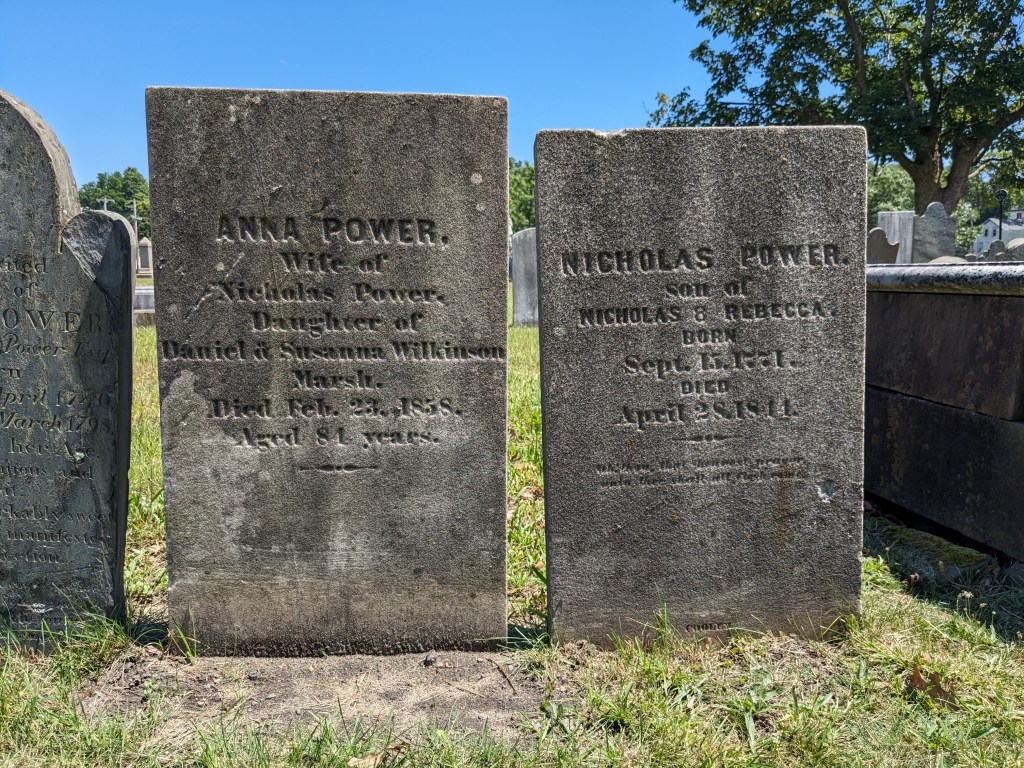
Power served his sentence, was released, and died shortly after on April 28, 1844. His wake was held at his wife’s home on Benefit Street, forcing her to deal with him one last time. He was buried next to his parents at the North Burial Ground in the Power family lot. Anna Power would join his side in 1858. It is almost certain that she rolled over in her grave the minute she was placed in it.
A note about the above image of Nicholas Power: The miniature painted by Edward Greene Malbone in 1794 is the only know image of Power that exists. The painting remained in the hands of his daughter, Sarah Helen Whitman, until her death in 1878. She donated it to The Providence Athenaeum where it remained until the 1970s when it was stolen. Today, the painting has still not been recovered. In Tolman’s 1958 biography of the artist titled, The Life and Works of Edward Greene Malbone, the author incorrectly labels Nicholas Power’s portrait as Dr. G. Patten of Newport, R.I., and labels Patten’s portrait as Power.
 Edgar Allan Poe: Rhode Island