Susan Anna Power (1813-1877) was the fifth and final child born to Nicholas and Anna Power. Susan was born after two siblings that died in infancy. She was named after her older sister that passed away in February, 1809. Her family called her Anna, though not to be confused with her mother.
| 1. Rebecca Power Staples, 1800-1825, 25 years old. |
| 2. Sarah Helen Power Whitman, 1803-1878, 75 years old. |
| 3. Susan Anna Power, 1806-1809, 3 years old. |
| 4. Nicholas Power VII, 1811-1811, 5 months old. |
| 5. Susan Anna Power, 1813-1877, 64 years old. |
In her lifetime, Susan was described as “eccentric.” Without proper diagnoses in the early nineteenth century, it is hard to know what exactly afflicted Susan. However, anecdotal evidence tells us that she suffered from a mental illness. At times, she was short-tempered and often dictated what went on in the household. In her later years, Susan would even become quite violent on her bad days. The family decided that it was best to let her have her own way, as she caused much anxiety otherwise. She was briefly committed to the care of a physician in 1845, but her mother’s overprotective nature did not allow her absence from the home for very long. She returned from the physician’s care within a few months, unchanged. Because of Susan’s unpredictable behaviors, houseguests would often be turned away. When company did enter the house, Susan would usually hide in a closet to avoid interaction. When their mother was on her deathbed in 1858, she begged her oldest surviving daughter, Sarah Helen Whitman, to look after Susan. Whitman promised her mother that she would, and when Anna died in 1858, Whitman kept that promise. Susan became a lifelong companion of her older sister.
Although not much has been documented about Susan, we know that she was a poet like her older sister. Together, they composed a few fairytale poems that were included in both editions of Whitman’s published poetry. Susan was also responsible for writing the little couplet that became the anthem to her father’s controversial legacy (if you are not aware of Nicholas Power’s story, read about him here):
Mr. Nicholas Power left home in a sailing vessel bound
for St. Kitts,
When he returned, he frightened his family out of their
wits.
While Susan had a presence in literature, it was only known by a small circle of people. Her poetic contributions remained incognito. She was a lifelong lover of poetry but she disliked people—which made her fear of being in the public eye. She wrote and contributed her work anonymously to publications like the Knickerbocker and Yankee Doodle. Susan had a particular interest in public affairs, which seemed to influence her work. In one of her most notable poems, “Dissolving Views,” published in 1868, she quotes Draper’s Human Physiology: “In that phantasmal exhibition which we call history events give birth to events, as in dissolving views, the phantoms of the actors stalking one after another.”
Since Whitman was certain that Susan would outlive her, she had taken every precaution necessary to ensure that her younger sister would be taken care of in the event of her death. She budgeted savings for Susan to live off of and had friends promise to take care of her. These efforts proved in vain when Susan died in her sister’s arms on December 8, 1877. The very last poem that Whitman would ever write in her career was a requiem for Susan titled “In Memoriam.” There is no known occasion when Susan sat before a photographer’s lens, which leaves even more intrigue behind this important person in Whitman’s life.
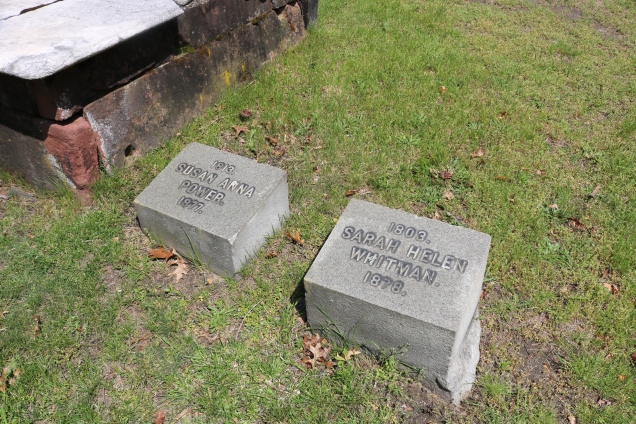
Susan was buried at the North Burial Ground, where Whitman would join her side only six months later.
 Edgar Allan Poe: Rhode Island