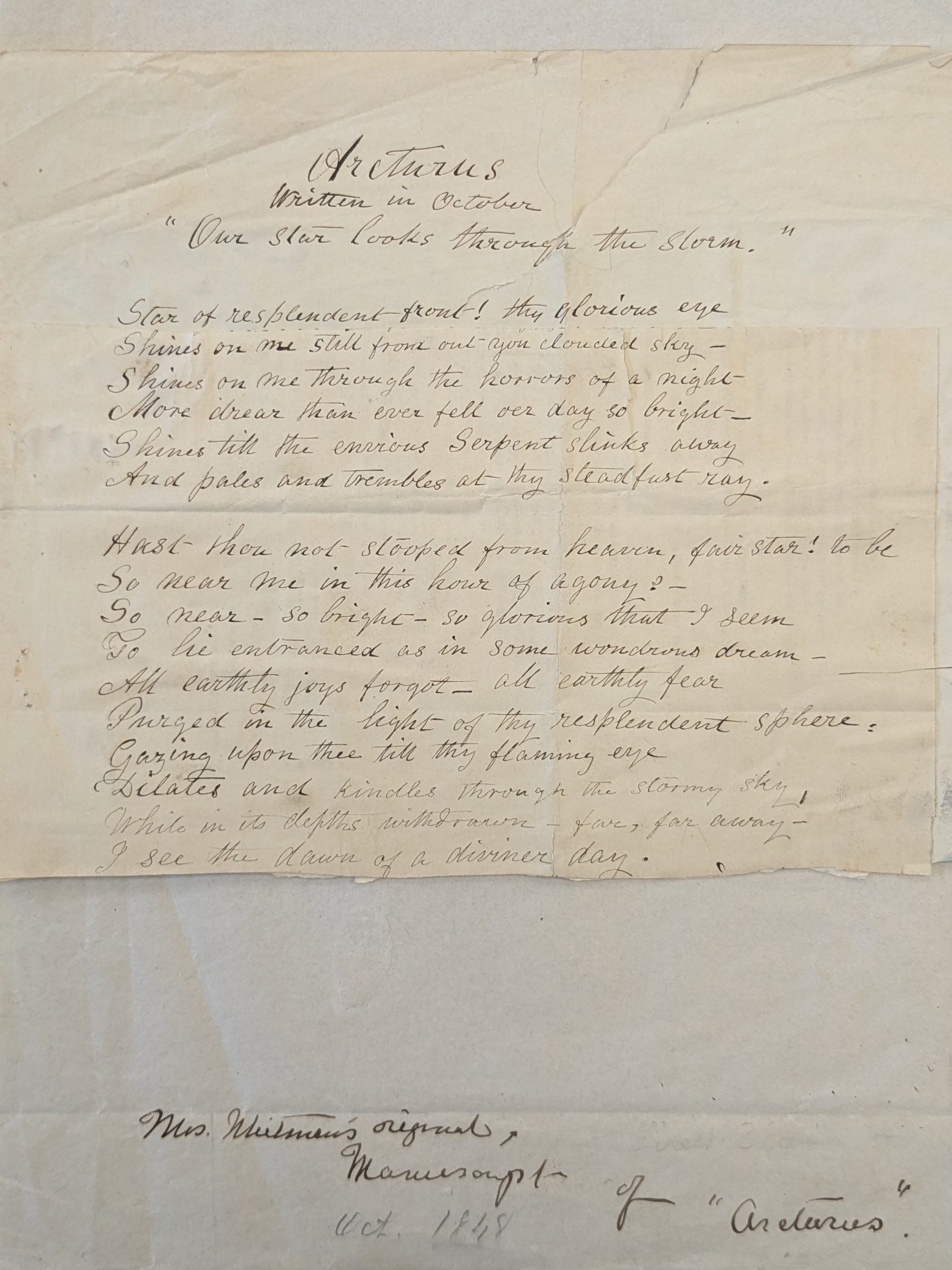
It was a sensational experience the first time I sat down at the John Hay Library to read through Sarah Helen Whitman’s papers. There was something other-worldly about handling her personal manuscripts—my bare fingers on the brittle parchment that her hands once touched. I remember sitting down and opening Folder 1 of Box 1, prepared for a journey into my favorite chapter of literary history. That first folder contained her manuscript of “Arcturus, Written in October.” She would write another variation of the poem, “Arcturus, Written in April,” but the former poem carries a poignant history.
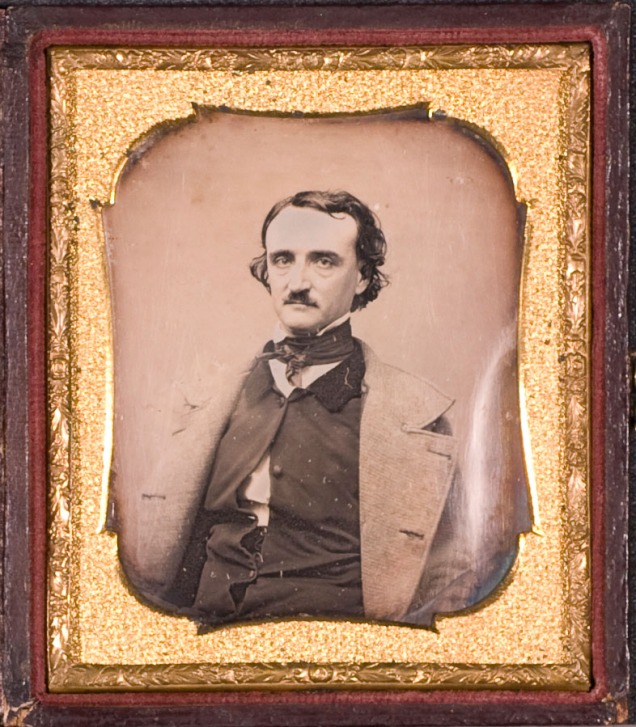
Ironically, the first version of the poem was not written in October, but in November 1848 (a final draft would be written the following October). Whitman was two months into her courtship with Edgar Allan Poe, and she had just agreed to a conditional engagement, requiring Poe to abstain from alcohol in order for the marriage to proceed. Poe vowed sobriety and made his way to the Studio of Masury and Hartshorn on Westminster Street to sit for the only known daguerreotype that he would commission of himself. He found the resulting image to be the best likeness of him ever taken. That evening, he presented it to Whitman as an engagement gift.
Before he departed home to Fordham, New York, he mentioned the brightest star in the northern constellation, Arcturus, and romantically linked the star to their engagement: destined and bright. He left his prospective bride that evening, hopeful of a happy future together.
After Poe’s departure, Whitman’s mother erupted into angry protest over their engagement, vexed by his inability to support her financially. Whitman sat silently, absorbing her mother’s painful words, until her gaze drifted out the window. Shining brightly through a break in the clouds, she spotted Arcturus. It was in that symbolic moment she saw her own metaphor: “Our star looks through the storm.” At 1:00 A.M., Whitman composed the lines “To Arcturus” under what she called “a strange accession of prophetic exaltation.”
Star of resplendent front! thy glorious eye
Shines on me still from out yon clouded sky—
Shines on me through the horrors of a night
More drear than ever fell o’er day so bright
Shines till the envious Serpent slinks away
And pales and trembles at thy steadfast ray.
Hast thou not stooped from heaven, fair star! to be
So near me in this hour of agony?—
So near—so bright—so glorious, that I seem
To lie entranced as in some wondrous dream—
All earthly joys forgot—all earthly fear
Purged in the light of thy resplendent sphere:
Gazing upon thee, till thy flaming eye
Dilates and kindles through the stormy sky;
While, in its depths withdrawn—far, far away—
I see the dawn of a diviner day.
The following week, Whitman sent the poem to Poe, but it appears that she crossed out the last two lines. In a reply letter dated November 26, Poe wrote:
My sole hope, now, is in you, Helen. As you are true to me or fail me, so do I live or die.
I forgot to reenclose your poem & do so now. Why have you omitted the two forcible lines—
While in its depths withdrawn, far, far away—
I see the dawn of a diviner day?
—is that dawn no longer perceptible?
Whitman harbored reservations about the engagement from the beginning, but this moment suggests something much deeper: she could not bring herself to grant Poe more hope than he had already. Was a failed engagement inevitable? Was Whitman ever truly ready to marry him? The romance was ill-fated from nearly every angle—yet the engagement carried on.
A resurgence of optimism followed Whitman’s attendance at Poe’s December 20 lecture at Howard’s Hall, delivered before a sold-out audience of two-thousand people. She arranged a wedding to take place on Christmas Day, but two days before the planned ceremony, fate—or destiny, intervened. Whitman received an anonymous note alleging that Poe drank a glass of wine at his hotel that very morning—breaking his promise to her, the one on which their marriage depended.
A dramatic scene unfolded in her living room later that evening. Whitman called off the wedding and collapsed in an ether-induced slumber. Poe was expelled from the house by her mother, and this time he would not return.
Prophetically, those lines in their omission would be the chief metaphor for their romance, and “the dawn of a diviner day” would never come. He died the year following.
Even the brightest stars must burn out, at last.

 Edgar Allan Poe: Rhode Island