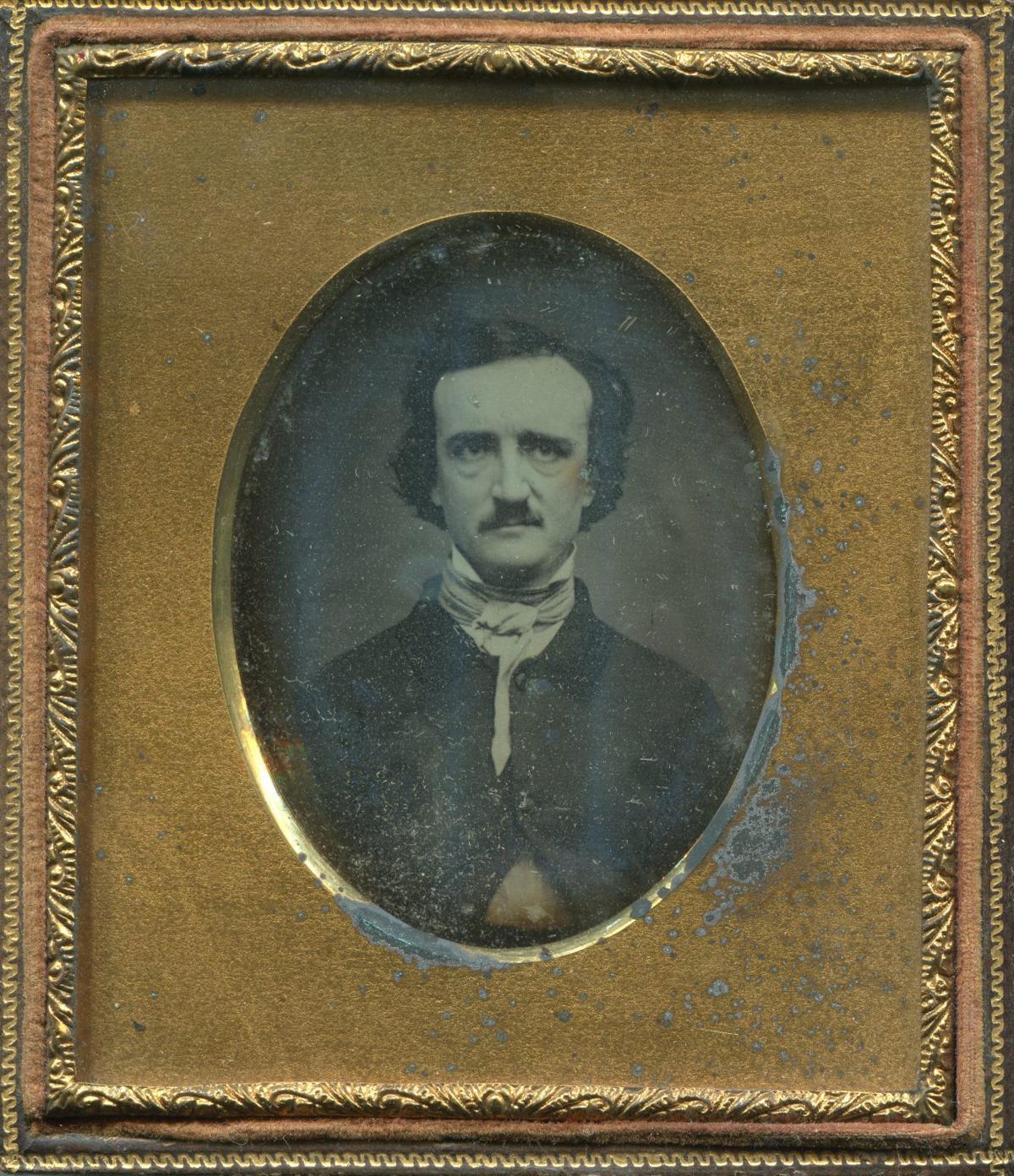
This daguerreotype is undoubtedly the most iconic image of Poe that exists today, while it can even be credited as one of the most famous literary photographs of the nineteenth century. It was taken in Providence on November 9, 1848 at Masury and Hartshorn’s studio on Westminster Street. However, this particular daguerreotype was taken by their assistant photographer, Edwin Manchester, who later operated his own studio in Providence with his brother Henry. Unfortunately, the original buildings that housed the studios are no longer standing.
The “Ultima Thule” was named by Sarah Helen Whitman after a Latin phrase from Poe’s poem “Dream-Land.” The term translates to “extreme limits of travel and discovery.”
I have reached these lands but newly
From an ultimate dim Thule —
From a wild weird clime that lieth, sublime
Out of SPACE — out of TIME
After Whitman rejected Poe’s proposal of marriage, he attempted suicide by consuming one of two ounces of laudanum that he had obtained in Providence. Laudanum is a tincture of opium and alcohol, equivalent to morphine. In Poe’s time, laudanum was prescribed for pain management. Poe had boarded a train to Boston, and upon arrival, took the first dose of the drug. He had miscalculated the strength of that dose and became too ill to take the second dose that would have ultimately ended his life. That suicide attempt occurred just four days before he sat for this picture.
Most of the daguerreotype’s provenance comes from Whitman herself. In a letter to Poe biographer John Henry Ingram, Whitman writes: “It was taken after a wild distracted night, and all the stormy grandeur of that via Dolorosa had left its sullen shadow on his brow.” That “wild distracted night” Whitman described took place at the Earl House, the hotel Poe was staying at while in Providence.
Poe began drinking, and at some point during the evening, he encountered a man who addressed himself as Mr. MacFarlane. MacFarlane befriended Poe and drank with him throughout the night. The following morning, MacFarlane took Poe to the daguerreotype studio and paid for the sitting.
After leaving the studio, Poe made his way to Whitman’s home on Benefit Street. She recounted that he arrived in great distress, “calling upon me to save him from some terrible impending doom. The tones of his voice were appalling and rang through the house. Never have I heard anything so awful, even to sublimity. It was long before I could nerve myself to see him when my mother requested me to have a cup of strong coffee prepared for him, he clung to me so frantically as to tear away a piece of the muslin dress I wore.”
Whitman’s mother had called on a local physician, Dr. Okie, to come to the house and examine Poe. Okie advised that Poe stay at the home of a friend to have a proper eye kept on him. William Pabodie volunteered to take Poe into his home and care for him over the next few days.
The original daguerreotype remained on display at Masury and Hartshorn’s studio until they relocated to Boston in 1850. They passed the daguerreotype down to their assistants, the Manchester Brothers, who were operating a studio of their own in Providence. It remained with them until around 1860 when it vanished for good. Fortunately, at least five copies were made before the photo disappeared. It is still undetermined whether it was stolen, lost, or destroyed.
 Edgar Allan Poe: Rhode Island